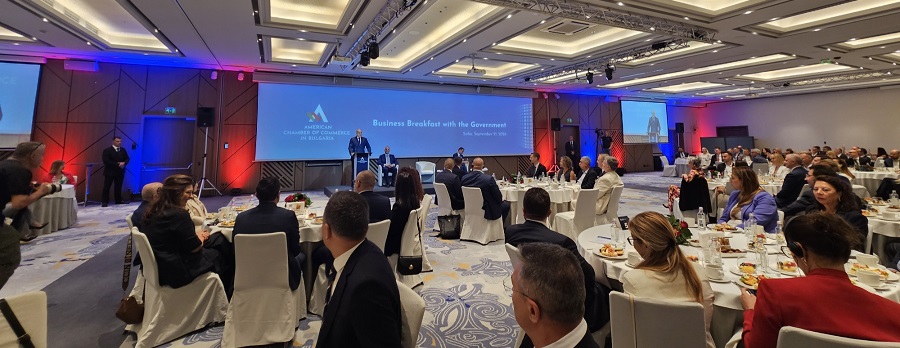
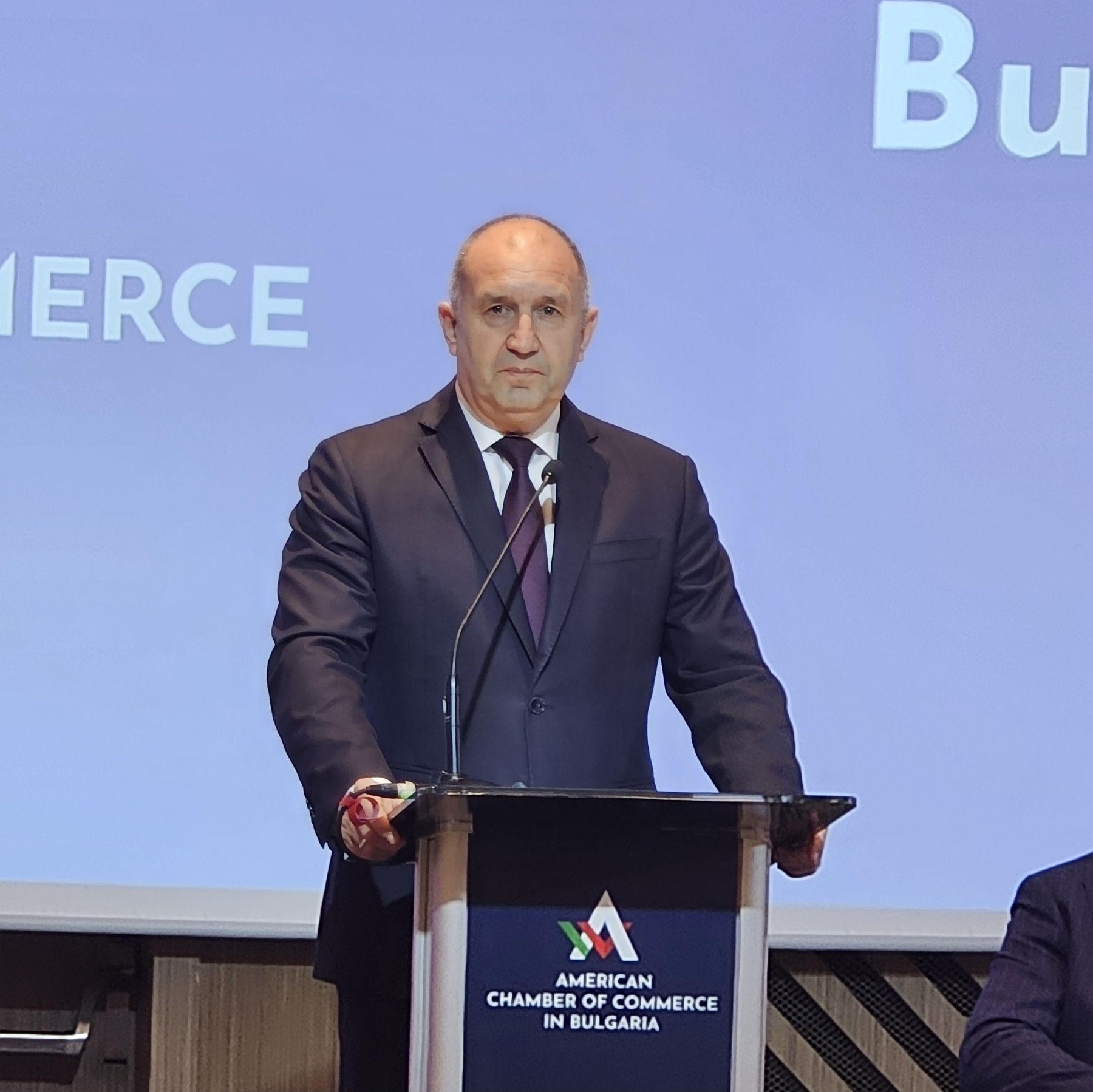
On 21 September 2026 in Sofia, the American Chamber of Commerce in Bulgaria (AmCham Bulgaria) organised a high-level Business Breakfast with Prime Minister Rumen Radev and members of the Bulgarian Government, bringing together senior government representatives, bilateral chambers and members of the local business community for a direct discussion on Bulgaria’s economic priorities, investment environment and key areas of public policy.
The Hellenic Business Council in Bulgaria (HBCB) was represented by Kalin Yonov, Vice President of HBCB, responsible for relations with state institutions.
Opening remarks were delivered by Tommy Ver Elst, President of AmCham Bulgaria, and Prime Minister Rumen Radev. The discussion was moderated by Ivan Mihaylov, CEO of AmCham Bulgaria.
The Government was represented by Alexander Poulev, Deputy Prime Minister and Minister of Economy, Investments and Industry; Nataliya Efremova, Minister of Labor and Social Policy; Katya Ivkova, Minister of Health; Ivan Vasilev, Minister of Innovation and Digital Transformation; Nikolay Naydenov, Minister of Justice; Ivan Demerdzhiev, Minister of Interior; Hristo Polendakov, Deputy Minister of Foreign Affairs; and Lyubomira Gancheva, Deputy Minister of Energy.
Six months into the Government’s mandate, the meeting provided the business community with an opportunity to hear directly from the Prime Minister and members of the Cabinet about the Government’s assessment of the current economic environment, its priorities and the measures moving into implementation.
A New Economic Development Model
Prime Minister Rumen Radev placed strong emphasis on the Government’s efforts to dismantle what he described as the oligarchic model and to strengthen transparency in the use of public resources.
In this context, Prime Minister Radev highlighted SIGMA, the newly introduced system designed to monitor public spending and procurement and increase transparency regarding the flow of public resources to private companies across ministries, state institutions and municipalities.
Prime Minister Radev also outlined what he described as a new direction for Bulgaria’s economic development, aimed at moving away from a model heavily dependent on low-cost labour and towards investment, production, exports and higher-value-added economic activity.
According to the Prime Minister, the Government’s objective is to build an economy increasingly based on high-value-added production, stronger foreign direct investment and higher economic growth, with the aim of improving Bulgaria’s competitiveness and establishing a more sustainable foundation for the country’s long-term economic development.
Of particular importance to the corporate sector, Prime Minister Radev stated that the Government is not considering changes to the corporate tax base. Against the background of the current budget deficit, the Government instead intends to focus on improving tax collection, drawing also on the Greek experience, and bringing high-tax-risk sectors, including construction, further into the formal economy.
Economy, Investment and Administrative Reform
Alexander Poulev, Deputy Prime Minister and Minister of Economy, Investments and Industry, outlined the Government’s intensive dialogue with bilateral chambers of commerce and sectoral associations. These consultations are intended to lay the foundations for a broad reduction of bureaucratic and administrative burdens affecting businesses.
New intergovernmental committees have also been established with several key investment partner countries, including Greece. These mechanisms are expected to facilitate investment and joint projects in strategic areas such as infrastructure, defence and artificial intelligence.
Minister Poulev also highlighted the Government’s objective to establish a unified digital point of access through the central e-government portal, allowing Bulgarian citizens to access state administrative services through a single interface.
Energy and Strategic Infrastructure
In his remarks, Prime Minister Rumen Radev highlighted Bulgaria’s growing strategic role in regional energy connectivity. In the natural gas sector, the Prime Minister stated that Bulgaria is positioned to transport significantly larger volumes of liquefied natural gas from terminals in Greece and Turkey towards Central and Eastern Europe, particularly in light of forthcoming EU restrictions on Russian gas imports.
Prime Minister Radev also pointed to Bulgaria’s electricity generation capacity and significant share of renewable energy as competitive advantages for attracting AI-related data centres. He indicated that discussions with potential US and European investors are already underway.
Lyubomira Gancheva, Deputy Minister of Energy, stated that intensive discussions are underway with Westinghouse and Hyundai regarding the construction of Units 7 and 8 at Kozloduy Nuclear Power Plant. The Government is reviewing the existing memoranda and technical specifications and expects substantial steps forward during 2027.
Deputy Minister Gancheva also referred to the further deployment of battery energy storage systems and the development of new pumped-storage hydroelectric power capacity.
Infrastructure and Public-Private Partnerships
Prime Minister Rumen Radev also outlined infrastructure development as a major priority of the Government. He stated that the Government intends to proceed with a substantial pipeline of infrastructure projects, with particular emphasis on the further development of Bulgaria’s national road network and state and private industrial zones.
According to the Prime Minister, major projects are expected to advance in 2027. In parallel, the Government is preparing new legislation governing public-private partnerships, intended to facilitate broader participation of private capital in state infrastructure projects, including projects in the energy sector.
Justice
Nikolay Naydenov, Minister of Justice, focused his remarks on measures aimed at increasing the efficiency and transparency of Bulgaria’s judicial system.
Healthcare
Katya Ivkova, Minister of Health, stated that the Government intends to restrict the opening of additional hospitals where new capacity would compete with existing state healthcare infrastructure.
Minister Ivkova noted Bulgaria’s high number of hospital beds per capita compared with other European countries and stressed the need to focus on quality, efficiency and transparency rather than simply adding capacity.
She also referred to cases identified by the authorities involving misuse of public resources in the healthcare sector and emphasised the need for stronger transparency and control.
Innovation and Technology Transfer
Ivan Vasilev, Minister of Innovation and Digital Transformation, presented initiatives aimed at strengthening technology transfer and cooperation in areas including deep tech, process automation and industrial robotics.
The initiatives presented are intended to support Bulgaria’s transition towards higher-value-added economic activities and strengthen cooperation between business, research and technology sectors.
HBCB: Strengthening the Dialogue Between Greek Business and Bulgarian Institutions
For the Greek business community operating in Bulgaria, the discussion addressed several areas of particular importance: predictable taxation, institutional transparency, reduced administrative burden, modern infrastructure, energy security and the transition towards a higher-value-added economy.
The establishment of new bilateral mechanisms with Greece also creates further opportunities for strengthening economic cooperation and developing joint investment projects between the two countries.
Through its participation in the meeting, HBCB reaffirmed its commitment to maintaining an active and constructive dialogue with Bulgarian state institutions and to representing the interests of the Greek business community operating in Bulgaria.